
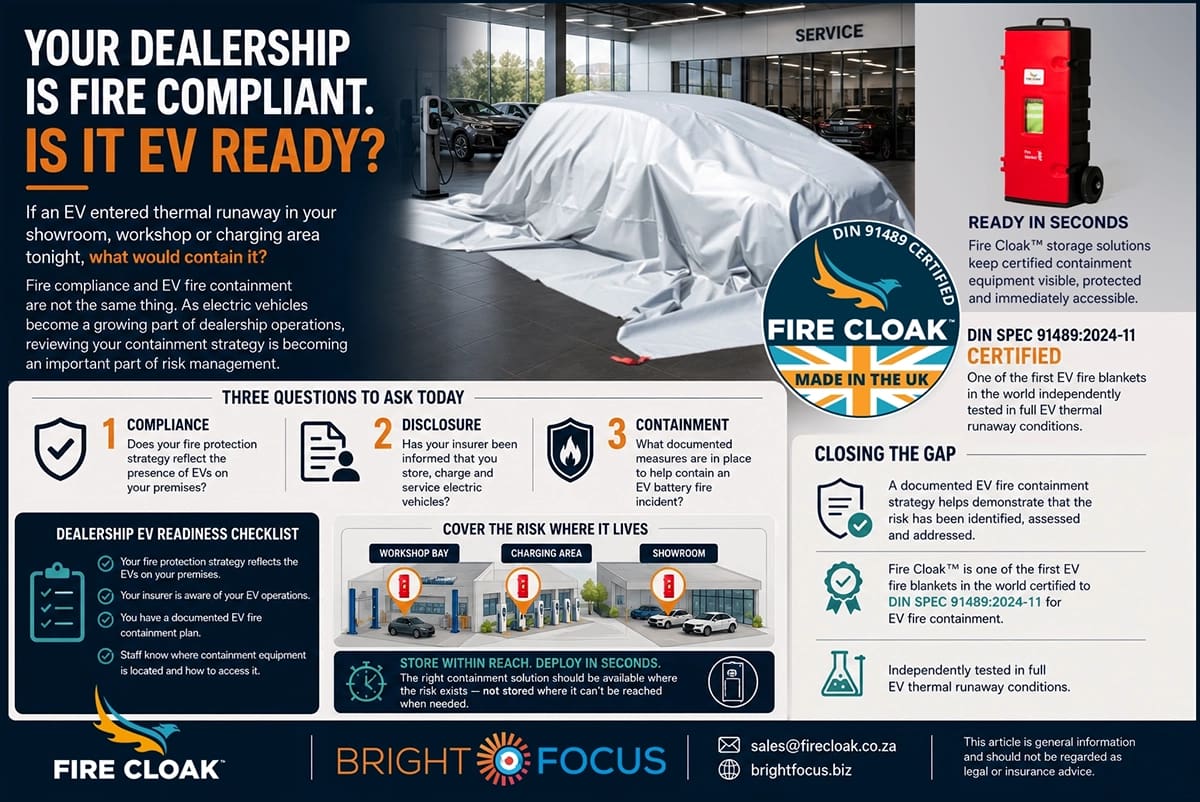
Your dealership is fire compliant. Is it EV ready?
Why compliance alone may not be enough in the EV era — and what South African dealerships should be reviewing today.
Most Dealer Principals can produce a fire compliance certificate on request.
Far fewer can answer a more practical question:
If an electric vehicle on your premises entered thermal runaway tonight, what would your containment plan be?
As electric vehicles become an increasingly common part of dealership operations, the conversation around fire safety is evolving. Compliance remains essential, but preparedness is becoming just as important.
For many dealerships, existing fire protection measures were designed around conventional vehicle risks. The question is whether those same measures adequately address the unique challenges presented by lithium-ion battery systems.
Compliance and containment are not the same thing
South African fire compliance for commercial premises is governed through the National Building Regulations Act and SANS 10400 Part T, supported by the Occupational Health and Safety Act and standards covering extinguishers, fire detection and sprinkler systems.
It is a robust framework that serves dealerships well.
However, most of these standards were developed long before electric vehicles became a significant part of daily workshop, charging and showroom operations.
Lithium-ion battery incidents differ substantially from conventional vehicle fires. In the rare event of thermal runaway, temperatures can exceed 900°C, reignition can occur hours after apparent extinguishment, and conventional suppression systems may not provide the containment required to prevent escalation.
As a result, a dealership can be fully compliant from a regulatory perspective while still having limited capability to contain an EV battery fire should one occur.
Compliance remains essential. Preparedness is the next step.
Why insurers are paying attention
As EV adoption increases, insurers are taking a closer look at how businesses identify and manage emerging risks.
Three areas are worth reviewing.
1. Fire protection measures
Following any significant fire event, insurers will typically assess what reasonable mitigation measures were in place. As dealerships increasingly store, charge and service EVs, the expectation for documented risk management may evolve alongside the technology itself.
2. Risk disclosure
The introduction of EV servicing, charging infrastructure and battery storage can alter a dealership’s risk profile. It is good practice to ensure insurers are aware of these changes and that cover remains aligned with current operations.
3. Emerging industry standards
The South African Insurance Association (SAIA) has identified EV battery fires as an emerging risk category, highlighting the challenges associated with containment, emergency response and limited local claims history.
As underwriting practices develop, dealerships that can demonstrate a proactive approach to EV fire risk management may find themselves in a stronger position than those relying solely on legacy protection measures.
Building an EV containment strategy
The good news is that developing an EV fire containment strategy does not require a complete overhaul of existing fire protection systems.
It starts with identifying where EV-related risks exist within the dealership and ensuring suitable containment measures are available where they may be needed.
For most dealerships, this means considering:
- Workshop bays servicing EVs
- Customer charging areas
- Vehicle preparation areas
- Showroom display vehicles
- Battery storage locations
The objective is not simply to respond to an incident, but to demonstrate that the risk has been recognised, assessed and addressed.
The importance of certification
As with any safety-critical product, independent certification matters.
Fire Cloak™ is one of the first EV fire blankets in the world certified to DIN SPEC 91489:2024-11, an internationally recognised standard specifically developed for EV fire containment.
In independent live-burn testing conducted at Horiba MIRA in the United Kingdom, a vehicle experiencing thermal runaway was successfully contained within seconds, with internal temperatures reducing from over 900°C to 47°C in under ten minutes.
For dealerships, certified containment measures provide more than operational protection. They provide documented evidence that reasonable steps have been taken to manage a known risk.
A simple EV readiness checklist
If your dealership stores, charges or services electric vehicles, consider reviewing the following:
✓ Does your fire protection strategy reflect the presence of EVs on your premises?
✓ Has your insurer been informed of any changes to your EV operations?
✓ Do you have documented EV fire containment measures in place?
✓ Is containment equipment available where the risk exists?
✓ Do staff know where it is located and how it would be deployed?
These are relatively simple questions, but they can help identify gaps before they become problems.
Looking ahead
Electric vehicles are becoming a normal part of dealership life. As that transition continues, fire safety planning will naturally evolve alongside it.
The dealerships best positioned for the future are unlikely to be those doing the bare minimum to remain compliant. They will be the ones taking practical steps to ensure they are prepared.
Because in the EV era, compliance is important.
Readiness is better.

